Setting an automated blog system to push live immediately guarantees that unverified errors will eventually reach your readers. The mistake of publishing straight to production without a review hold turns minor hallucinations or formatting glitches into public embarrassments. A mandatory pause between generation and publication allows a human editor to verify facts, fix layouts, and ensure the content strictly follows instructions before anyone else sees it.
What happens when automated posts go live immediately?

When a script writes directly to a public URL, any error in the prompt or the generation pipeline becomes a live defect. An API timeout, a misunderstood instruction, or a markdown parsing error goes directly to your homepage.
The immediate consequence is visible to your most loyal audience. RSS feeds update instantly. If you use Ghost, email newsletters trigger the moment the post status changes to published. You cannot recall an email. A draft containing an invented API endpoint or a broken image link lands in hundreds of inboxes.
Search engine bots also index live pages quickly. If a post goes live with missing meta descriptions or repetitive headings, Google sees the flawed version first. Correcting the page later requires waiting for the next crawl, which might take weeks for a new domain.
Downstream automation breaks. If you are automatically turning blog posts into social media posts, a live error on the blog immediately cascades to your social channels. Fixing a typo requires editing the CMS, then hunting down multiple social posts to delete or amend them before too many people notice.
Why does generated content require a mandatory pause?
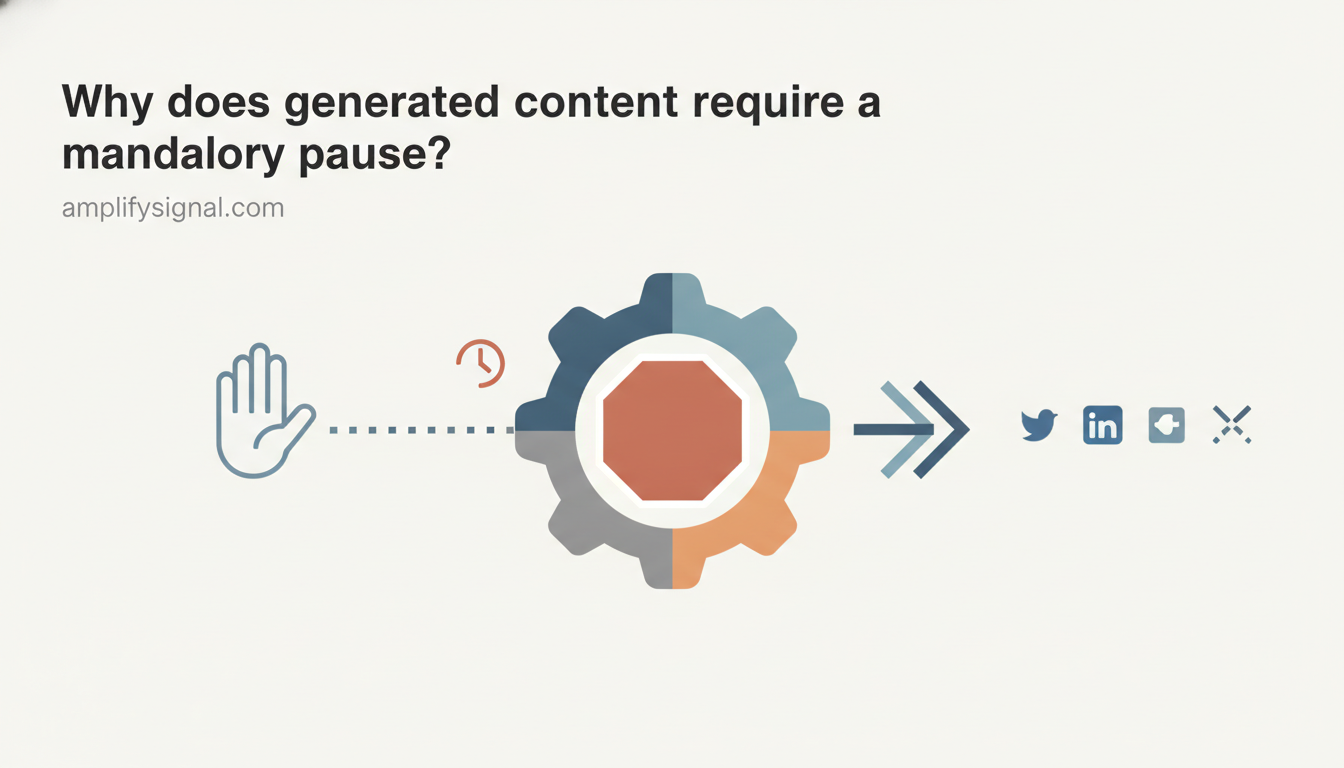
Large language models occasionally misinterpret instructions or invent facts, requiring a human editor to catch deviations from reality. The technology predicts text based on patterns; it does not test the code it writes or verify the history it claims.
Even when you spend time writing standing instructions for your automation, an edge case will eventually slip through. The system might include a forbidden word, hallucinate a feature you do not offer, or invent a false performance metric. The model tries to be helpful, and sometimes being helpful means making up a plausible-sounding answer.
The pause is your quality control layer. It shifts the burden of blogging from writing entirely from scratch to editing a finished draft. Editing a thousand words takes five to ten minutes. Writing those same words takes two hours. The pause ensures those five minutes actually happen.
You know your product and your audience better than any script. When reading a drafted post, you instantly spot a sentence that feels out of place or a technical explanation that misses the nuance of your specific stack. The pause gives you the authority to reject, rewrite, or approve.
How do you implement a safe review pipeline?
A safe pipeline sets the API payload status to draft rather than published when sending the article to your content management system. This physical barrier at the API level prevents any script from accidentally triggering a live update.
Both Ghost and WordPress accept REST API requests that specify post status. By hardcoding the draft status in your publishing webhook, you isolate the generation environment from the public-facing site. The script does its job, deposits the file, and stops.
Your workflow then becomes asynchronous. You open the CMS dashboard when you have time, review the pending drafts, check the layout in the site preview, and manually click publish or set a scheduled time.
I made this an optional setting when I built AmplifySignal to run my own sites. The system drafts the post against your site line and keyword, sends it to Ghost or WordPress, and holds it there. Nothing goes to the live domain until you clear the review hold. You maintain total control over what your domain broadcasts.
Does a manual check defeat the purpose of automation?
A manual check protects the value of automation by ensuring the output remains accurate while still saving the hours usually spent drafting. The goal of automating a blog is not to remove humans completely, but to remove the friction of the blank page.
Staring at an empty text editor requires significant time and creative energy. Reading a pre-written draft to verify its logic takes a fraction of that effort. The automation handles the heavy lifting of structure, formatting, and initial phrasing.
You still save massive amounts of time. The automation takes a keyword, reads your instructions, structures the headings, and generates the HTML. The human simply provides the final stamp of reality. The efficiency gains remain, but the risk of publishing garbage drops to zero.
Knowing a review hold is active actually frees you to use automation more aggressively. You can confidently set up pipelines to generate posts from striking distance keywords without worrying that a strange or broken article will suddenly appear on your homepage while you sleep. The safety net encourages higher volume testing.
What specific checks belong in the review phase?
The review phase exists to verify technical accuracy, confirm link functionality, and enforce your specific formatting constraints. This step is about catching the things a machine cannot verify independently.
Technical accuracy is the priority. If the article mentions code snippets, terminal commands, or UI steps, you read through to ensure those steps match reality. An automated system cannot run the code to test it. You have to verify that a reader following the tutorial will actually get the promised result.
Next, you click every link in the draft. You ensure the URLs resolve to a 200 status code and point to the exact page intended. You check that internal links use natural anchor text and lead to relevant articles on your own domain.
Finally, you check the visual formatting. You look at heading hierarchies to ensure H2s and H3s nest correctly. You verify that code blocks render clearly in your specific site theme. If your instructions forbid bulleted listicles, you verify the draft uses standard paragraphs. You preview the post on both desktop and mobile views.
How do review holds interact with social distribution?
The review hold halts the entire downstream distribution chain until the parent blog post officially goes live. Social media automation depends entirely on the published blog URL existing and returning a valid response.
If the blog post remains in draft, the automation cannot extract the final permalink. It cannot scrape the meta description or the featured image. The pause creates a natural synchronization point. The social engine waits patiently for the CMS to signal that the article is public.
Once the review hold is lifted and the article publishes, the social sequence begins. In my setup, a post goes to Bluesky about two hours later. A LinkedIn post queues up for the next morning to catch early traffic. X, Threads, and Mastodon are manual: the system generates prefilled composer links so you can click and post.
Occasionally, network issues happen exactly when you approve a draft. This is why implementing exponential backoff strategies is vital. If the connection to Bluesky fails at the two-hour mark, the system waits and retries, ensuring the delayed social post still goes out eventually.
How long should a draft sit in the review queue?
A draft should sit in the review queue for at least twenty-four hours to separate the generation phase from the editing phase. Reviewing a post the second it generates often leads to skimming, where you see what you expect rather than what is actually on the screen.
Waiting a day resets your attention. When you open the CMS the next morning, you read the draft with fresh eyes. Awkward phrasing stands out immediately. Missing transitions become obvious. You catch errors you would have ignored if you reviewed it in a rush.
A queue also helps pace your output. You might generate five drafts in a single batch on Monday based on search console data. Instead of publishing them all Tuesday, you leave them in the CMS. You review and schedule them to drip out slowly over the month.
If you are wondering how often a small site should publish, a healthy review queue is the answer. It allows you to maintain a steady schedule of one or two posts a week without scrambling for content. The queue absorbs the variability of your free time.